Thank you! We'll get back to you within two business days.
Something went wrong. Please try again or email us at hello@bluedynamic.cz.
Business Consultants
Adriana Pricop & Štěpán Kněžek
We'll get back to you within two business days.
/
article
/
10 Key Components of Dynamics 365
Published:
20.5.2020
The World of Dynamics 365 – Do You Know All It Can Do?
Omnichannel
Lately, the word “omnichannel” keeps coming up more and more in retail. What does omnichannel mean from a customer’s point of view? What does it mean for retailers? And how easy is it to get ready for it? If you’re after answers to these questions, you’re in the right place.
Looking at the word purely from a linguistic angle, “omnichannel” splits into two parts – omni and channel. Omni comes from Latin and is essentially a prefix meaning “all.” Channel means, well, “channel” — in our context, a sales channel or a channel for communicating with customers. Put the two together and you get “all channels.”
Omnichannel is made up of two words, omni and channel. Omni = a prefix meaning “all,” and channel meaning a sales or communication channel for reaching customers
How the Customer Sees It
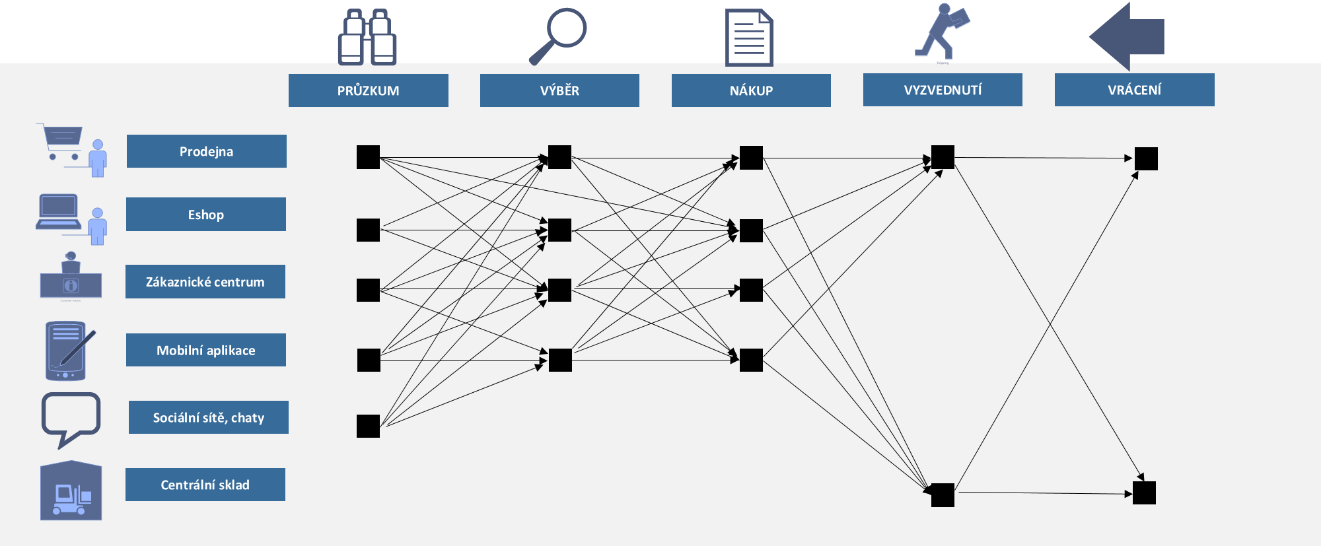
And that’s exactly what it is. Omnichannel means integrating every possible sales and communication channel into a single whole. To understand what omnichannel means for the customer, let’s break a typical purchase down into its individual steps: researching the market, choosing the goods or service, making the actual purchase (placing the order), and possibly returning the item or filing a complaint.
A customer performs every one of these steps during a purchase. A properly working omnichannel setup means the customer can pick any available sales channel for any of these steps and, whatever combination of step and channel they choose, they always get “the same experience.” It doesn’t matter which path they take to make their purchase — no path is better or worse than another. That lets the customer focus on the purchase itself, without worrying, say, that they won’t get expert advice in the store and will have to go look up the specs of the smart TV they want on the e-shop themselves.
The whole omnichannel principle can be illustrated with this diagram:
And What About Retailers?
Today’s customers are steadily starting to take omnichannel for granted, which can put pressure on retailers to adapt to the trend quickly. At the same time, though, omnichannel represents a huge opportunity. Opening up new communication channels means being able to engage the customer on multiple fronts. Tracking customer behavior across an omnichannel setup also makes it possible to understand their needs better — something a savvy retailer can easily turn into a competitive advantage.
So what does omnichannel actually look like in practice? Its typical hallmarks are:
Every channel offers the same range of products at the same prices, including add-on services
Products are equally available to the customer no matter where they’re shopping
Loyalty programs work across all channels
Customer support is consistent across all channels – a shop assistant can offer advice just as good as a call-center agent or an e-shop chat operator
An order can be started anywhere (say, on the website) and completed anywhere else (say, picked up in-store)
What Role Does IT Play?
Putting omnichannel into practice takes more than just well-managed business processes — it also requires a well-functioning information system. Data integration in particular is essential, which in practice mainly means:
Products, along with their descriptions and attributes, are available identically across all channels
All channels have access to real-time stock availability information
Customer data and purchase history are shared as well, which matters especially for loyalty programs to work properly
Beyond data integration, omnichannel also calls for functional integration. If you run a discount program, for instance, the discount calculation needs to produce the same result every time, whether the customer applies it on the website, in-store, or through the call center.
Take a look at how a customer might behave, and who needs access to the order for the customer to be able to complete it easily
Another example of functional integration is order processing itself. Picture this scenario: a customer places an order on the e-shop for home delivery. Then they change their mind and call the call center to say they’ll pick the goods up in person at the store instead. While there, they add something to the order, pay, and leave. Handling a case like this requires an integrated order-processing function — the order has to be accessible to both call-center staff and store staff, and either side needs to be able to modify it freely.
Rolling out omnichannel requires retailers to implement an integrated information system. One example of a solution that natively supports omnichannel is Microsoft Dynamics 365.
We’ll take a closer look at exactly how Dynamics 365 can help with omnichannel in one of our upcoming articles.
10 Key Components of Dynamics 365
Let's talk
/ Whether you know exactly what you need or just want to explore opportunities and possibilities.