Thank you! We'll get back to you within two business days.
Something went wrong. Please try again or email us at hello@bluedynamic.cz.
Business Consultants
Adriana Pricop & Štěpán Kněžek
We'll get back to you within two business days.
/
article
/
Business in Cloud Time — Migrating to the Cloud from the CIO's Perspective
Published:
1.8.2023
So how do you meet the challenge of cloud migration and how do you tackle it?
We're not there yet (in the cloud)
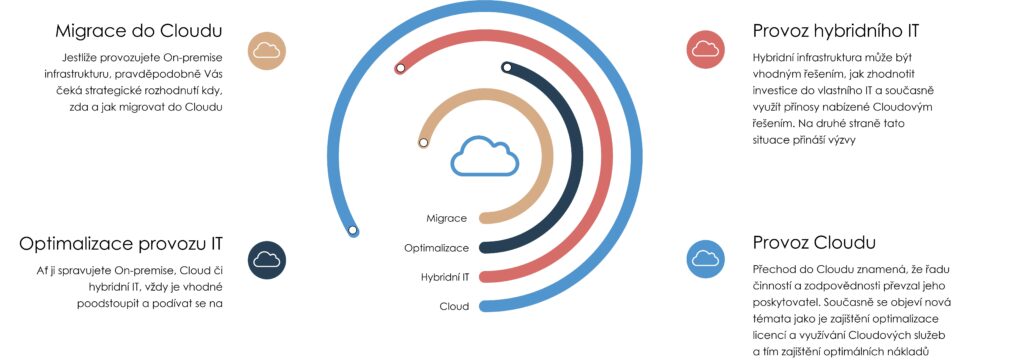
In this case, you probably run your own on-premise infrastructure and are considering, planning or looking for solutions to adapt your current IT infrastructure, in which you have invested a lot of money, to the current needs of your company and trends in IT.
First of all, it is necessary to ensure the functioning of the current systems:
The next point is planning the next steps. First of all, it is necessary:
Revise the architecture
select compliant cloud services
choose what to go to the cloud and what to keep “at home”
prepare management for the changes that await the organization, including changes in costs from investments to operating costs
No matter how you feel about the cloud in your personal life, we live in the digital age, so we can't ignore the existence of the cloud. The times are such that we probably can't ignore Cloud, no matter what we think of him. We do business in the cloud era, so we can say with confidence that whoever is not already in the cloud will soon be in it. For most businesses and their IT directors, this means that they are either already there or are waiting for them soon.
Migrating to the cloud: what is the preparation?
To migrate to cloud approach responsibly and with a carefully prepared strategy. Don't look at it as an unmanageable task, but as an opportunity to reflect on your organization's needs, your IT architecture, and your overall IT strategy. To help you with this, we have summarized some key aspects to consider:
Analysis and planning: The IT director should conduct a thorough analysis of the existing infrastructure and evaluate whether it is appropriate to move certain services or applications to the cloud. It should assess the benefits and risks associated with migration and develop a thorough migration plan.
Supplier evaluation: It is important to evaluate the different cloud service providers and choose the one that best suits the needs of the organization. The director should evaluate parameters such as performance, availability, safety and cost. Nor should he underestimate the issue of IT support offered by contractors.
Security and data protection: The IT director must consider the security aspects of the cloud and verify that the organization's needs will be met. It should focus primarily on implementing appropriate security measures, backing up data, and addressing privacy and compliance issues.
Costs and financial planning: Moving to the cloud can have significant financial impacts. The IT director should conduct a careful cost-benefit analysis, include operating costs, licensing and administration. Last but not least, it should evaluate whether the organization is able to cover the costs of migrating and operating the cloud.
Migration and Administration: The IT director should develop a cloud migration plan that will include the gradual move of services and applications to the cloud with minimal impact on the organization's operations. It is also important to ensure effective management and monitoring of the cloud after migration.
Staff training and preparationMigrating to the cloud usually requires that appropriately trained employees of the organization in the context of the news that migration will bring. The IT director should ensure that training takes place and employees are prepared to work in the cloud and use new tools and technologies.
Monitoring and Optimization: After migrating to the cloud, it is important to regularly monitor and optimize resource usage and costs. The IT director should maintain communication with the cloud provider, monitor performance and security, and conduct regular audit checks.
What reward awaits us?
What can you expect from such a change? The rewards of migrating IT infrastructure to the cloud should be for you and your organization to reduce costs, increase flexibility, increase availability, improve security, and ease of innovation adaptation.
Flexibility and scalabilityCloud services allow you to quickly and easily adapt capacity and performance to your organization's current needs. The IT director can simply increase or decrease the use of resources and scale the infrastructure depending on the current demand.
Cost reduction: Cloud services can deliver cost savings compared to running your own on-premise infrastructure. Organizations do not need to invest in their own hardware and data centers to minimize infrastructure maintenance and management costs. Thus, the organization pays only for the resources actually used.
High availability and durability: Cloud providers often offer high levels of availability and resilience. How to imagine this in practice? Thanks to the cloud, organizations can access their data and services virtually nonstop without downtime, resulting in greater reliability and continuity of operations.
Fast implementation and updates: Cloud services enable the rapid implementation of new applications and updates. The IT director can leverage the various tools and platforms available in the cloud for effective software deployment and management.
Security and data backup: Cloud providers typically invest in security measures and data backup mechanisms. This can improve data protection and reduce the risk of data loss in the event of a crash.
Innovative technologiesCloud services often offer advanced technologies such as artificial intelligence, machine learning, big data and the Internet of Things (IoT). The IT director can leverage these innovations and integrate them into company processes and applications.
In addition to the positives, it should be mentioned that the migration to the cloud entails a number of challenges and tasks that the IT director will have to face. This includes planning and managing migration, ensuring data security and concurrent operations with on-premise infrastructure, vendor and contract management, employee training, and more. Therefore, cloud migration needs to be carefully prepared and have the support of experts available so that the proposed strategy fits the needs of the organization.
We're already there (in the Cloud) — partially or completely
The cloud is changing the way IT works. Even if your cloud migration is over, don't fall asleep on your laurels and dedicate yourself to the cloud. Above all, you need to analyze and measure the benefits that an existing cloud solution brings to you and, if possible, optimize your operating costs.
If a hybrid infrastructure is operating in your organization, you need to choose a strategy that effectively evaluates and ensures optimal use of the cloud, while ensuring the tools and processes of control over the combined infrastructure, such as:
monitoring
Strategy for dealing with incidents and requirements
When operating a cloud infrastructure, you have several important tasks:
Before we close this topic, it needs to be said that there are many new things waiting for you when it comes to migrating to the cloud. Perhaps the biggest news for CIOs and those responsible for IT in the organization is the shift of attention to two new areas, namely:
monitoring costs and optimizing them
monitoring of innovations in the field of cloud services and their adaptation, both for reasons of cost optimization, as well as for the benefits and benefits for business development.
Conclusion
Migrating to the cloud brings many benefits as well as challenges. Regardless of whether your organization is planning to migrate or is already in the cloud, you should remember that IT directors play and will play a key role in the process. Strategy planning, cost management, employee training and performance monitoring are just some of the tasks they will have to face. It is important not only to monitor costs and optimize them, but also to be up to date and keep abreast of new trends and innovations in cloud services. For your business to succeed in today's digital age, it's crucial to move to the cloud responsibly and with a well-prepared strategy.
Business in Cloud Time — Migrating to the Cloud from the CIO's Perspective
Let's talk
/ Whether you know exactly what you need or just want to explore opportunities and possibilities.